


Product Overview
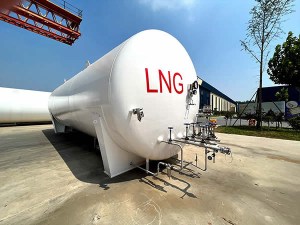
This liquefied natural gas (LNG) storage tank is a specialized pressure vessel classified as a Category III pressure vessel. It is designed for the safe storage of LNG and undergoes rigorous manufacturing processes including flaw detection, hydrostatic and pneumatic pressure testing, and on-site inspection by technical supervision authorities. The finished product is issued with a pressure vessel inspection certificate.
The tank is available in both horizontal and vertical configurations, with working volumes ranging from 5m³ to 200m³ and pressure ratings of 0.6MPa, 0.8MPa, and 1.2MPa. These tanks are widely used in gas filling stations, reserve stations, large receiving terminals, and various industrial, transportation, and municipal applications.

LNG Storage Tank Key Specifications
The core technical parameters of the LNG storage tank are listed as follows, and all parameters comply with pressure vessel industry specifications and relevant quality inspection standards:
Product Type: LNG storage tank
Working Volume Range: 5m³ to 200m³, applicable to gas storage demands of various working conditions
Pressure Ratings: Three standard specifications of 0.6MPa, 0.8MPa and 1.2MPa, optional according to actual application scenarios
Installation Type: Horizontal and vertical installation options, adaptable to different site conditions
Vessel Classification: Category III pressure vessel, in line with national pressure vessel classification standards
Certifications: Equipped with pressure vessel inspection certificates issued by official technical supervision authorities, fully compliant with relevant industry regulations


Complete Technical Parameter Table
| No. | Type | Pressure (MPa) | Inner Vessel (mm) | Outer Shell (mm) | Overall Dimensions (mm) | Weight (kg) | Support |
|---|---|---|---|---|---|---|---|
| 1 | Horizontal | 0.8 | DN1400×2740×6 | DN1900×3360×8 | φ1316×5040 | 3,830 | Saddle |
| 2 | Horizontal | 0.8 | DN1800×3300×6 | DN2300×3910×8 | φ2316×5808 | 5,465 | Saddle |
| 3 | Horizontal | 0.8 | DN1800×5250×6 | DN2300×5860×8 | φ2316×7725 | 7,530 | Saddle |
| 4 | Horizontal | 0.8 | DN1900×6400×6 | DN2400×7020×8 | φ2416×8922 | 9,370 | Saddle |
| 5 | Horizontal | 0.8 | DN2400×5760×7 | DN2900×6440×8 | φ2916×8574 | 12,650 | Saddle |
| 6 | Horizontal | 0.8 | DN2600×8480×8 | DN3100×9080×8 | φ3116×11378 | 18,310 | Saddle |
| 7 | Horizontal | 0.8 | DN2500×11310×8 | DN3000×12110×8 | φ3016×14465 | 21,960 | Saddle |
| 8 | Horizontal | 0.8 | DN2900×14100×9 | DN3400×15020×10 | φ3424×17666 | 36,150 | Saddle |
| 9 | Horizontal | 0.8 | DN3200×17510×10 | DN3700×18730×10/12/14 | φ3728×21128 | 51,200 | Saddle |
| 10 | Horizontal | 0.8 | DN3500×19545×12 | DN4000×20245×12/14 | φ4028×23855 | 66,850 | Saddle |
| 11 | Horizontal | 1.2 | DN2400×5760×12 | DN2900×6440×10 | φ2920×8580 | 14,500 | Saddle |
| 12 | Horizontal | 1.2 | DN2500×11310×12 | DN3000×12110×10/12 | φ3020×14551 | 27,105 | Saddle |
| 13 | Horizontal | 1.2 | DN2800×15230×14 | DN3300×16150×12 | φ3324×18739 | 45,620 | Saddle |
| 14 | Vertical | 0.8 | DN1400×2740×6 | DN1900×3360×8 | φ1916×4572 | 3,950 | Saddle |
| 15 | Vertical | 0.8 | DN1800×3300×6 | DN2300×4000×8 | φ2316×5398 | 6,050 | Saddle |
Note: Data above is for reference only. Please refer to actual product and product manual for detailed specifications. In outer shell dimensions (e.g., 10/12/14), values represent different front and rear head thicknesses.


Applications
-
Gas filling stations: LNG refueling for vehicles
-
Reserve stations: Peak shaving and emergency gas supply
-
Large receiving terminals: LNG import and distribution
-
Energy supply: Industrial and municipal gas networks
-
Transportation: LNG fuel supply for heavy vehicles and vessels
-
Industrial production: Process gas supply for manufacturing
Key Advantages
1.Material Advantages
High-Quality Steel Sourcing
Raw materials are sourced from custom-rolled steel plates produced by leading domestic steel manufacturers, ensuring consistent and reliable material quality. This approach effectively reduces the number of longitudinal and circumferential welds as well as head splicing seams. The shell requires only edge trimming without generating significant scrap, improving material utilization while maintaining product quality.
Premium Welding Consumables
For conventional carbon steel submerged arc welding, American Lincoln welding wire and flux are used, ensuring stable and reliable welding quality with a clean, aesthetically pleasing finish.
Superior Paint Coating
Both domestic and imported paint options are available. The finished coating provides excellent weather resistance and a professional appearance.

2.Processing and Manufacturing Capabilities
Laser Cutting
Laser cutting technology delivers high precision with tolerances within ±0.05mm, ensuring weld quality. Heat exchanger baffles can be directly laser cut without additional processing.
Plasma Welding for Stainless Steel
For stainless steel with thickness ≤10mm, plasma welding is used for longitudinal and circumferential seams. This single-pass double-sided forming process reduces wire consumption, eliminates the carbon arc gouging step required by submerged arc welding, prevents carburization, and delivers a clean weld appearance with low heat input. Radiographic inspection pass rate exceeds 99%.
Automatic TIG Welding
Argon arc automatic welding machines provide stable, consistent welding quality with excellent weld appearance.

3.Specialized Production Line Advantages
Manufacturing is organized into over ten specialized workstations:
-
Material cutting
-
Head pressing
-
Shell rolling
-
Longitudinal and circumferential seam welding
-
Sub-assembly and final assembly
-
Machining
-
Heat treatment
-
Hydrostatic testing
-
Sandblasting
-
Painting
Each workstation is staffed by specialized personnel with secondary division of labor within each process, effectively improving work efficiency and product quality.

4.Manufacturing and Quality Control
The LNG storage tank undergoes rigorous quality inspection throughout the manufacturing process:
-
Material testing: Physical and chemical property analysis including mechanical properties and chemical composition
-
Non-destructive testing: X-ray radiographic inspection and magnetic particle inspection of welded joints, seams, and heads
-
Dimensional inspection: Geometric positioning of all pressure-bearing components
-
Performance testing: Sealing test, pressure resistance test, and all technical indicators affecting safe operation

Actual shipment photos:


Frequently Asked Questions (FAQ)
Q1: What is the capacity range available for LNG storage tanks?
A: Standard models range from 5m³ to 200m³. Custom sizes are available upon request.
Q2: What pressure ratings are available?
A: Available pressure ratings include 0.6MPa, 0.8MPa, and 1.2MPa.
Q3: What are the installation options?
A: Both horizontal and vertical installations are available.
Q4: What materials are used for the tank construction?
A: The inner vessel uses cryogenic-grade stainless steel, and the outer shell uses carbon steel with vacuum insulation.
Q5: What quality testing is performed on each tank?
A: Each tank undergoes radiographic inspection, hydrostatic testing, pneumatic testing, and final inspection by technical supervision authorities.
Q6: What certifications are provided?
A: A pressure vessel inspection certificate is issued by the technical supervision authority.
Q7: Can the tank be used for other cryogenic liquids besides LNG?
A: Yes, these tanks can be designed for other cryogenic applications such as LO2, LN2, LAr, and LCO2.
Q8: Can you customize the semi-trailer according to our requirements?
A: Yes, we offer custom designs based on specific client requirements.


