Global Compliance Standards
- Export to USA / Canada: Core compliance requires UL 2085 (Protected Tanks) + UL 142, supported by NFPA 30A and UL 913 for explosion-proof electrical systems.
- Export to the 27 EU Countries (Dual Mandatory Directives): Requires ATEX 2014/34/EU (Explosion Protection CE) + PED 2014/68/EU (Pressure Equipment CE). The tank body must comply with EN 13445, and the suppression material must comply with EN 14751.
- Core Shared Standards: NFPA 69 and EN 14751 govern the performance of aluminum alloy mesh materials. These standards serve as the baseline for judging the system’s explosion-proof capabilities.
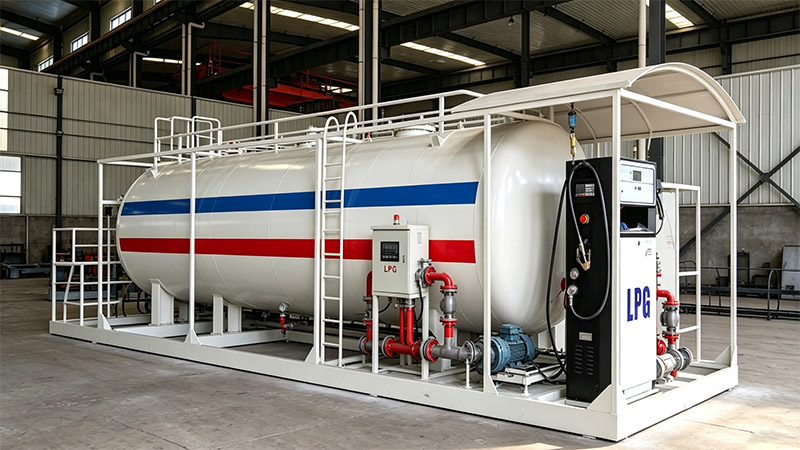
The integrated explosion-proof LPG skid-mounted fueling tank is the modern safety standard for internal fuel storage in mining, logistics, and industrial hubs. Its main advantage is a shift in safety logic. Instead of relying on thick tank walls to passively withstand a blast, it focuses on proactive prevention.
Engineered strictly to ATEX 2014/34/EU and PED 2014/68/EU directives, the system delivers “inherent safety.” It targets the root causes of explosions—stopping flame propagation, neutralizing ignition sources, and controlling environmental factors. The result? Even when exposed to open flames, high temperatures, or heavy impacts, the tank will not explode. It will only support a controlled, manageable fire.
This protective network relies on two core technologies and five safety systems working together.
1. Inherent Explosion Suppression (The Core)
The explosion suppression material is the most critical safety feature of the pressure tank, fully aligned with the strict performance requirements of EN 14751.
The tank is filled with a specialized, honeycomb-like aluminum alloy mesh. With a controlled filling density of 28 to 30 kg/m³, this dense mesh divides the large fuel cavity into millions of tiny, independent micro-compartments. This structure stops explosions through two distinct mechanisms:
- Free Radical Absorption (Chain Reaction Interruption): Fuel fires are chain reactions that require active free radicals to spread energy. The massive surface area of the aluminum mesh quickly captures these radicals. This breaks the chemical chain reaction and stops a small flame from escalating into a massive blast.
- Rapid Heat Dissipation (Pressure Control): Aluminum is an excellent heat conductor. It instantly draws away the high temperatures caused by localized ignition, balancing the temperature inside the tank. Tests show that under extreme conditions, internal pressure rise is kept ≤ 0.14 MPa—well below the tank’s bursting point. This completely eliminates the risk of a physical explosion caused by sudden pressure spikes.
Proven Reliability: Even at a 90% fuel level, tanks subjected to open fires, ballistic impacts, and direct welding did not rupture or spray fragments. They only produced a localized, controlled flame.
2. Double-Wall Physical Protection (Leak & Impact Defense)
Working alongside the internal mesh, the double-wall structure acts as a physical shield. It focuses on preventing leaks, blocking external heat, and absorbing impacts to ensure fuel vapor never mixes with outside air.
[Outer Wall: Structural Steel (S235JR Class)] ──> [100–150mm Monitored Insulation Gap] ──> [Inner Wall: Pressure Vessel Steel (EN 13445 compliant)]
- The Inner Tank: Built using high-grade pressure vessel steel compliant with EN 13445, this core chamber is tightly sealed and highly pressure-resistant for long-term fuel storage.
- The Outer Shell: Constructed from durable structural steel, it shields the inner tank from external impacts and open flames.
- The Interstitial Gap: A 100 to 150 mm sealed space separates the two layers. Inside, a high-precision leak detector monitors the space 24/7. If the inner tank develops a micro-leak, the system triggers a visual and audible alarm immediately. This gives operators early warning long before hazardous vapors can escape into the atmosphere.
3. Safe Pressure Relief & Flame Arresting
To handle overpressure, external fires, and pipe flashbacks, the tank features certified flame-arresting and pressure-relief components on all openings. Three key devices protect the tank:
- Flame-Arresting Breather Valve: This valve balances internal pressure during daily operations, preventing the tank from ballooning or collapsing. It features a built-in precision flame-arresting core that stops external sparks or flames from entering the tank.
- Emergency Relief Valve: In extreme heat or fire, this valve acts as a safety backup. It automatically opens to release vapor in a controlled direction, capping internal pressure and preventing structural failure.
- Flame-Arresting Manholes & Quick-Disconnect Couplings: Every pipe and port connected to the tank includes dedicated flame arrestors. This seals off all pathways to prevent a single point of failure from triggering a larger fire.
4. Total Ignition Source Control (ATEX Electrical System)
Electrical and static sparks are major culprits behind fuel explosions. This system uses a comprehensive spark-free design to achieve a certified Ex d IIB T4 explosion-proof rating.
- Explosion-Proof Components: All electrical parts—including the fuel dispenser, lighting, control boxes, and level sensors—use flameproof or intrinsically safe designs. All wiring is sealed inside flexible, explosion-proof conduits.
- Static Dissipation: The skid base includes integrated grounding and lightning protection systems. This continuously discharges static electricity during fuel loading and unloading.
- Friction-Free Piping: Fuel lines feature flexible metal connectors and explosion-proof ball valves, eliminating sparks or static buildup caused by mechanical friction during operation.
5. Environmental Risk Mitigation & Automated Fire Fighting
The final line of defense uses smart monitoring and active risk reduction to lower fuel vapor levels and extinguish early-stage fires.
- Stage-1 Vapor Recovery: The system recovers ≥ 95% of fuel vapors. By keeping the vapor concentration in the tank’s upper air space far below the explosive limit, it lowers the risk of ignition at the source.
- Automated Dry Powder Extinguisher: Positioned directly above the dispenser, this device monitors temperatures and flame activity. If it detects a sudden temperature spike or fire, it instantly deploys dry powder to smother the flame.
- Smart Interlocks: High-level shutoff valves, high-temperature fuel cutoffs, and combustible gas detectors work together automatically. If abnormal conditions occur, the system shuts down, cuts off fuel flow, and sounds an alarm.
Summary of the Safety Logic
The safety of an integrated explosion-proof LPG skid-mounted tank does not come from simply making the steel walls thicker. Instead, it relies on a smart, layered system:
Inherent Suppression (Core) → Physical Protection → Ignition Control → Pressure Relief → Smart Fire Mitigation
By strictly adhering to ATEX 2014/34/EU and PED 2014/68/EU directives, the tank controls chemical reactions, physical pressure changes, ignition sources, and vapor levels. This closed-loop safety design ensures true peace of mind throughout the entire fuel storage and dispensing process.