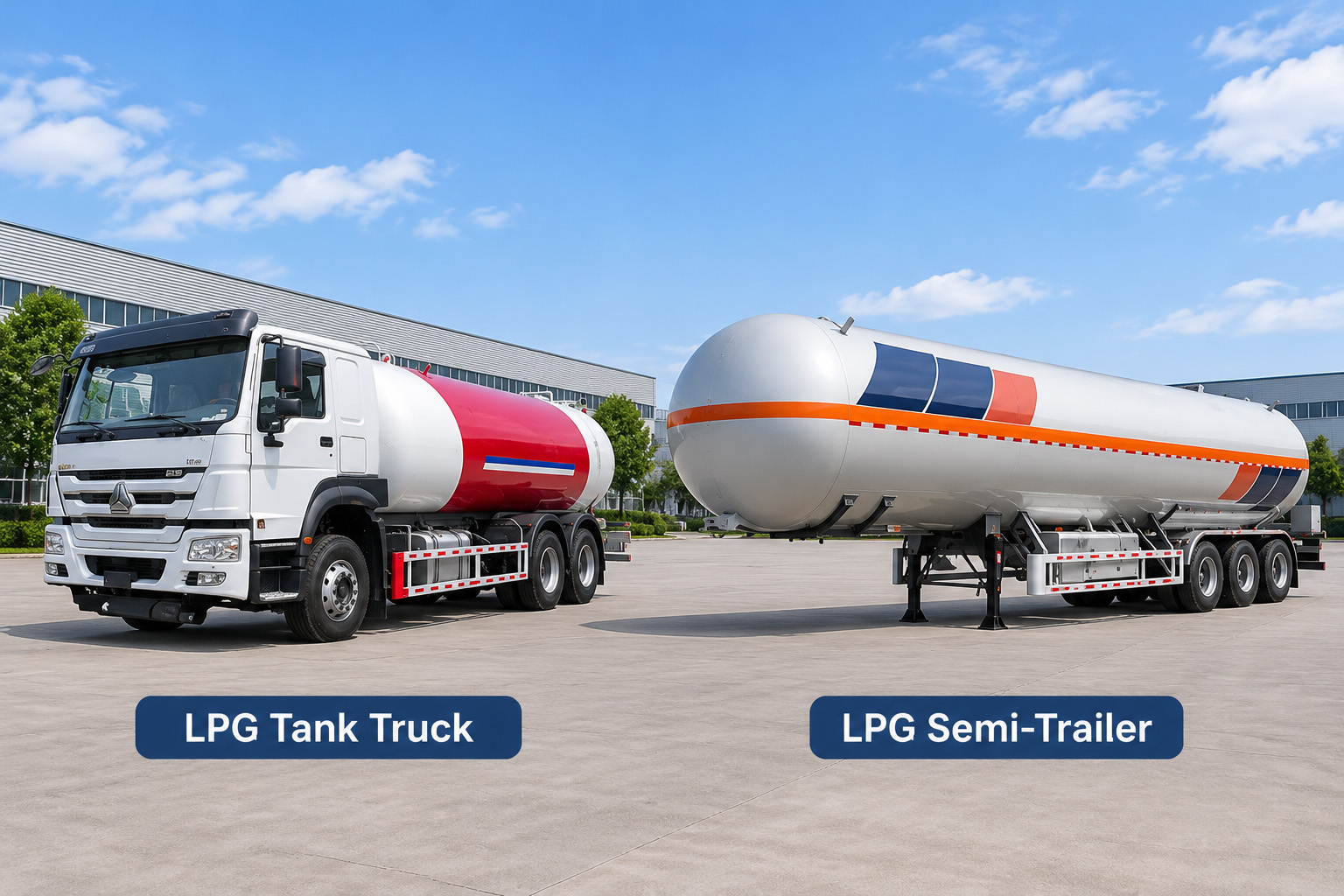
Buying the wrong LPG transport vehicle can cost your business more than you think. A large-capacity semi-trailer may be unnecessary for local deliveries, while a rigid LPG tank truck may not be efficient enough for long-distance bulk transportation.
So, should you invest in an LPG tank truck or an LPG semi-trailer?
The answer depends on your delivery routes, transportation volume, operating requirements, and budget.
In this guide, we’ll compare both vehicle types and help you choose the right solution for your LPG transportation business.
1. What Is an LPG Tank Truck?

An LPG tank truck is a complete vehicle with a pressure vessel mounted directly on a truck chassis. Unlike a semi-trailer, it does not require a separate tractor unit.
Depending on its configuration, an LPG tank truck can be used for bulk transportation, local distribution, and direct LPG delivery. Some models are equipped with pumps, flow meters, filling hoses, and other dispensing equipment.
These features make certain LPG tank trucks particularly useful for businesses that need to transport LPG and deliver it directly to customers.
Common Applications
LPG tank trucks are commonly used for:
- Delivering LPG to restaurants, hotels, and commercial users
- Replenishing small and medium-sized LPG storage tanks
- Supplying local gas distribution networks
- Mobile LPG refilling services
- Industrial and regional LPG transportation
For example, Jinlong Tank offers a Dongfeng LPG Bobtail Tank Truck with 5m³, 10m³, and 15m³ configurations. Its listed equipment includes an LPG pump, flow meter, filling gun, and hose.
Another option is the 20m³ LPG Bobtail Truck with Sinotruk HOWO Chassis, which features an integrated refilling system and safety monitoring equipment.
2. What Is an LPG Semi-Trailer?

An LPG semi-trailer is a separate pressure tank trailer that connects to a tractor unit through a fifth-wheel coupling.
Unlike a rigid LPG tank truck, the semi-trailer does not have its own engine or driving cab. It relies on a compatible tractor unit for transportation.
LPG semi-trailers are commonly selected for bulk gas transportation, particularly when large quantities of LPG need to be moved between refineries, storage terminals, distribution centers, and industrial facilities.
Common Applications
- Transporting bulk LPG between refineries and storage terminals
- Supplying large LPG storage facilities
- Long-distance commercial gas transportation
- Regional and cross-border LPG logistics
- Supporting large-scale energy and industrial projects
For companies handling substantial LPG volumes, a semi-trailer can be an effective option for bulk transportation.
Jinlong Tank offers several configurations, including the Compact 46m³ LPG Semi-Trailer, the 60.72m³ LPG Gas Transport Semi-Trailer, and the 61.9m³ LPG Semi-Trailer.
These models demonstrate how trailer capacity and dimensions can vary according to different transportation requirements.
3. LPG Tank Truck vs. LPG Semi-Trailer: What Are the Main Differences?
Both vehicle types are designed to transport LPG, but their structures and operating methods are different.
| Comparison | LPG Tank Truck | LPG Semi-Trailer |
|---|---|---|
| Vehicle structure | Tank mounted on a rigid truck chassis | Separate tank trailer connected to a tractor |
| Driving unit | Integrated into the vehicle | Requires a compatible tractor |
| Typical use | Local distribution and transportation | Bulk and long-distance transportation |
| Delivery equipment | Can include integrated pumps and filling systems | Depends on the loading and unloading configuration |
| Maneuverability | Often more convenient for frequent delivery stops | Depends on trailer dimensions and road conditions |
| Fleet management | Operates as one complete vehicle | Tractor and trailer can be managed separately |
| Best suited for | Flexible delivery operations | High-volume transportation operations |
These are general differences, not absolute rules. A large rigid LPG truck can also handle substantial loads, while a compact LPG semi-trailer can be designed for routes with specific size restrictions.
The right choice depends on the actual vehicle configuration and your operating conditions.
3.1 Vehicle Structure
The main difference is how the tank is connected to the vehicle.
An LPG tank truck has its pressure vessel mounted on a rigid chassis. The tank, chassis, engine, and cab operate as one complete unit.
An LPG semi-trailer has a separate tank trailer connected to a tractor. This means the tractor and trailer can be managed as separate fleet assets.
If your business needs a vehicle that is ready to operate as one integrated delivery unit, a rigid LPG tank truck may be more convenient.
If you already operate a fleet of suitable tractor units, a semi-trailer may offer more flexibility.
3.2 Transportation Capacity
Capacity is often one of the first things buyers compare.
Rigid LPG tank trucks are available in different sizes, depending on the chassis, tank design, and intended application. They are commonly used for local distribution and direct delivery.
LPG semi-trailers are often selected for larger bulk transportation tasks. However, the actual loading capacity depends on more than the tank’s geometric volume.
Buyers should also consider:
- Permitted filling ratio
- LPG density and loading temperature
- Tank design and operating pressure
- Vehicle tare weight
- Gross vehicle weight limits
- Axle load restrictions in the destination market
For example, Jinlong Tank’s 61.9m³ LPG semi-trailer has a listed gross vehicle weight of 40,000kg and a payload capacity of 25,998kg. These figures belong to that particular configuration and should not be treated as standard values for all LPG semi-trailers.
3.3 Maneuverability and Road Conditions
A rigid LPG tank truck may be more convenient for frequent deliveries, especially when the vehicle needs to enter commercial premises, smaller gas facilities, or locations with limited turning space.
A semi-trailer generally requires more attention to overall length, turning radius, road width, overhead clearance, and loading-site access.
However, vehicle type alone does not determine whether it can operate on a particular road.
For example, Jinlong Tank’s 46m³ compact LPG semi-trailer is designed with a shorter wheelbase and smaller overall dimensions to suit certain restricted routes and smaller LPG stations.
Before purchasing, compare the actual vehicle dimensions with your planned routes and delivery locations.
3.4 Loading and Unloading Requirements
Another important difference is how LPG is transferred at the loading and receiving points.
Some LPG bobtail trucks include integrated pumps, flow meters, filling hoses, and dispensing equipment. These systems can support direct delivery to customer storage facilities.
Semi-trailers may use different loading and unloading arrangements depending on the terminal infrastructure and customer requirements.
Before choosing a vehicle, consider whether your business needs:
- Direct delivery to customer tanks
- Bulk loading and unloading at terminals
- One-sided or two-sided liquid connections
- Integrated pumps and flow meters
- Specific hose and valve configurations
The vehicle should match your actual operating process, not just the transportation distance.
3.5 Fleet Flexibility
An LPG tank truck operates as one complete vehicle. If the chassis requires maintenance, the entire vehicle may become unavailable.
With a semi-trailer arrangement, the tractor and trailer are separate units. A compatible tractor may be able to pull another trailer when needed, depending on fleet availability and operating arrangements.
This can be useful for companies managing larger transportation fleets.
However, it also means you need to consider tractor compatibility, trailer parking, maintenance facilities, and the additional work involved in managing separate units.
4. Which Vehicle Is Better for Your LPG Business?
There is no single answer for every LPG distributor or transportation company. The better choice depends on your customers, routes, delivery volumes, and existing fleet.
Choose an LPG Tank Truck If:
- Your business mainly handles local or regional LPG deliveries.
- You frequently serve restaurants, hotels, commercial users, or smaller gas stations.
- Your customers need direct replenishment of storage tanks.
- You require an integrated pump and dispensing system.
- Your delivery locations have limited turning or parking space.
For example, a regional LPG distributor delivering gas to multiple commercial customers may find a rigid bobtail truck more convenient for daily operations.
Choose an LPG Semi-Trailer If:
- Your business transports large quantities of LPG.
- Your routes connect refineries, terminals, and large storage facilities.
- You handle long-distance bulk transportation.
- Your company already operates compatible tractor units.
- Your loading and unloading facilities can accommodate larger vehicles.
For example, a gas logistics company transporting LPG from a refinery to a regional storage terminal may benefit from a higher-capacity semi-trailer.
What If Your Routes Have Restrictions?
Do not overlook local road conditions when selecting an LPG vehicle.
Check the following before placing an order:
- Maximum permitted vehicle length and width
- Height restrictions along the route
- Bridge and axle load limits
- Turning radius requirements
- Access conditions at loading and unloading facilities
- Local dangerous goods transportation regulations
A larger trailer may offer more volume per trip, but it may not be the most practical option if it cannot access your intended delivery locations.
5. What Should You Check Before Buying an LPG Tank Truck or Semi-Trailer?
Once you have decided which vehicle type suits your business, the next step is checking its technical specifications.
For LPG transportation equipment, the purchase price is only one part of the decision. Tank design, safety systems, chassis configuration, documentation, and local compliance are equally important.
1. Tank Capacity and Filling Requirements
Start by confirming the required tank volume and expected LPG loading weight.
Consider your average delivery volume, transportation distance, loading frequency, and receiving facility capacity.
Ask the manufacturer to clarify the permitted filling ratio and maximum allowable loading weight for the proposed configuration.
Do not assume that a larger geometric tank volume automatically means a proportionally larger payload.
2. Tank Material and Pressure Design
LPG is transported as a pressurized liquefied gas, so the tank must be designed for the intended medium and operating conditions.
Ask the supplier about:
- Pressure vessel design code
- Design pressure and operating pressure
- Design temperature
- Tank material and plate thickness
- Welding procedures and inspection records
- Pressure testing and inspection documentation
The final design should meet the applicable regulations and technical requirements in your destination market.
3. Safety Valves and Monitoring Equipment
Safety equipment is essential for LPG transportation.
Depending on the vehicle design, the configuration may include:
- Pressure gauges
- Temperature indicators
- Liquid level gauges
- Pressure relief valves
- Emergency shut-off valves
- Gas and liquid phase connections
- Appropriate loading and unloading equipment
Ask for a detailed equipment list before confirming the order. Make sure the selected configuration is suitable for your operating procedures.
4. Chassis, Axles, and Suspension
For an LPG tank truck, check the chassis brand, engine, axle configuration, braking system, and permitted vehicle weight.
For an LPG semi-trailer, pay attention to:
- Axle number and axle load rating
- Suspension system
- Braking system, including ABS or EBS where specified
- Tires and rims
- Landing gear
- Kingpin compatibility
- Tractor and trailer connection requirements
These components affect vehicle performance, maintenance planning, and operating suitability.
5. Loading and Unloading Configuration
Not every LPG transportation vehicle uses the same delivery arrangement.
Some rigid LPG trucks are equipped with pumps, flow meters, hoses, and dispensing systems for direct customer delivery.
Semi-trailers may use different loading and unloading configurations depending on the terminal infrastructure and customer requirements.
Explain how your company loads and unloads LPG so the manufacturer can recommend a configuration that matches your workflow.
6. Certifications and Local Regulations
LPG transportation is subject to strict safety and vehicle regulations.
Requirements vary by country and may depend on the pressure vessel design, vehicle classification, dangerous goods transport rules, and road registration standards.
Before production, confirm which design codes, inspections, certificates, and vehicle approvals are required in your destination market.
It is better to clarify these requirements before signing the technical agreement than to discover a compliance issue after manufacturing.
7. After-Sales Support and Spare Parts
An LPG transport vehicle is a long-term investment, so after-sales support deserves attention.
Ask the supplier about:
- Spare parts availability
- Technical documentation
- Maintenance guidance
- Warranty terms
- Remote technical assistance
- Support for commissioning and troubleshooting
A competitive purchase price is useful, but reliable support can make a significant difference throughout the vehicle’s service life.
6. Why Consider Jinlong Tank for LPG Transportation Equipment?
Choosing a manufacturer is about more than finding a vehicle with the right tank volume.
Buyers also need to understand the manufacturer’s production capabilities, pressure vessel experience, quality control procedures, and ability to configure equipment for different markets.
Jinlong Tank supplies LPG transportation equipment, including rigid LPG tank trucks and LPG semi-trailers.
The product range includes different bobtail truck capacities and semi-trailer configurations for bulk gas transportation.
You can explore the following products:
- LPG Tanker Truck Range
- LPG Semi-Trailer Range
- Dongfeng LPG Bobtail Tank Truck
- 61.9m³ LPG Semi-Trailer
Before confirming an order, discuss your intended application, route conditions, required capacity, destination regulations, and preferred equipment configuration with the manufacturer.
7. Frequently Asked Questions
Q1: What is the main difference between an LPG tank truck and an LPG semi-trailer?
An LPG tank truck has its pressure tank mounted on a rigid truck chassis, with the driving unit integrated into the vehicle. An LPG semi-trailer is a separate tank trailer that must be connected to a compatible tractor unit.
Q2: Which is better for long-distance LPG transportation?
An LPG semi-trailer is often suitable for high-volume, long-distance bulk transportation. However, the final decision depends on road regulations, vehicle capacity, tractor availability, and route conditions.
Q3: Is an LPG tank truck suitable for local gas distribution?
Yes. Rigid LPG tank trucks, especially bobtail models equipped with pumps and dispensing systems, can be suitable for delivering LPG to commercial users and smaller storage facilities.
Q4: Does an LPG semi-trailer always have a larger capacity?
No. Semi-trailers are commonly designed for larger bulk loads, but capacity varies by model. Buyers should compare actual tank volume, allowable filling weight, gross vehicle weight, and local regulations.
Q5: Can an LPG semi-trailer be connected to any tractor unit?
Not necessarily. The tractor must be compatible with the trailer’s kingpin, fifth-wheel coupling, weight requirements, braking connections, and other technical specifications.
Q6: What information should I provide when requesting an LPG vehicle quotation?
To help the manufacturer recommend a suitable configuration, prepare the following information:
- Vehicle type: rigid LPG tank truck or LPG semi-trailer
- Required tank capacity
- LPG medium and intended application
- Destination country
- Planned transportation routes
- Local vehicle and pressure vessel regulations
- Preferred chassis, axle, and suspension configuration
- Required loading and unloading equipment
- Applicable certification requirements
Providing these details helps the supplier prepare a more accurate technical proposal.
Conclusion
An LPG tank truck and an LPG semi-trailer serve different transportation needs.
An LPG tank truck is often a practical option for local delivery, smaller customer orders, and mobile refilling services. An LPG semi-trailer is generally more suitable for high-volume transportation between refineries, terminals, and regional storage facilities.
Before making a purchase, look beyond tank capacity. Compare the vehicle structure, route conditions, loading requirements, safety configuration, and local compliance standards.
The right vehicle is not necessarily the largest or the cheapest one. It is the one that fits your transportation business and can operate efficiently over the long term.
Looking for an LPG tank truck or semi-trailer for your business? Explore the Jinlong Tank LPG product range and contact our team to discuss your project requirements.